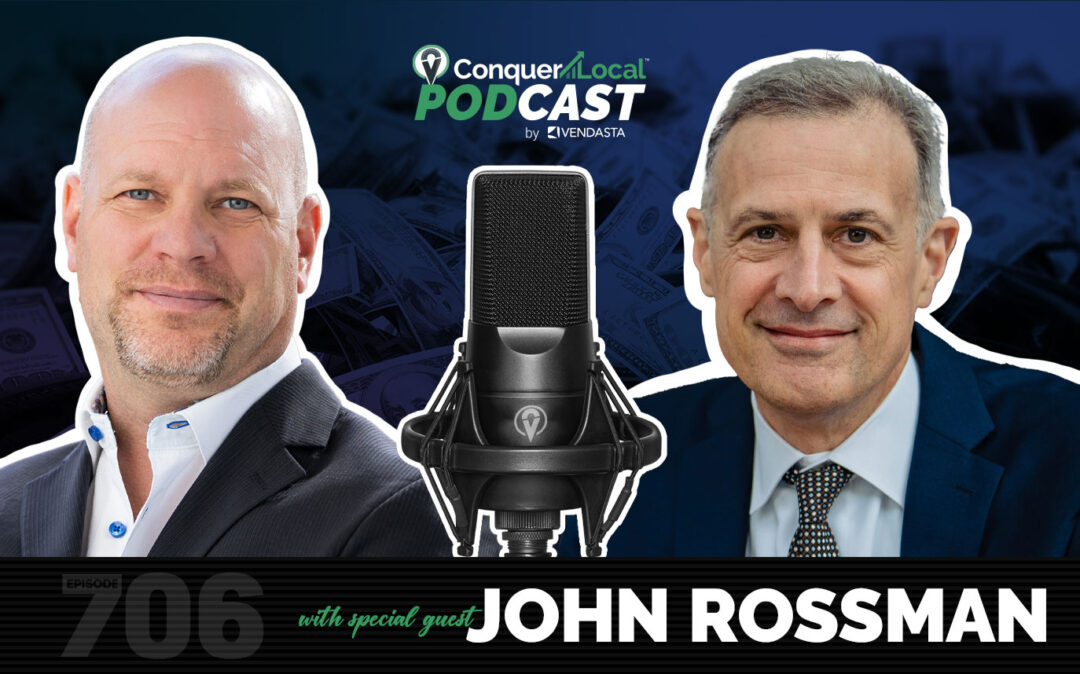
John Rossman is one of those guests you book and then realize you should have booked for two episodes. A founder of Rossman Partners, an early Amazon executive who played a pivotal role in launching Amazon Marketplace, and the author of four books on leadership and business innovation including the bestseller The Amazon Way. My colleague Jeff Tomlin hosted this conversation on the Conquer Local Podcast, and I want to share my own takeaways because the frameworks John laid out apply to every business I work with.
Transforming In The Hyper Digital Era
John’s thesis is that the pace of change is no longer a phase we are passing through. It is the operating condition. Businesses that treat transformation as a project with a finish line keep getting lapped. Businesses that build transformation into their operating rhythm become the ones everyone else is trying to catch.
That is the Amazon DNA in a sentence. Every initiative is a test. Every test is measured against input and output metrics. Every result informs the next investment decision. You do not get stuck betting on a vision that was outdated the moment you wrote it down.
Accelerating Risk And Value Validation
John shared a framework I’ve been chewing on ever since. Before you build anything expensive, you need to accelerate your risk and value validation. In plain language, find the riskiest assumptions in your idea and prove them out first. Defer everything else until you know the core bet is sound.
He put it this way:
“Once you’ve proven that out, you’ve really de-risked the initiative. It’s no longer a bet anymore, it’s just an investment.”
That is the difference between a product or service that actually scales and a long running project that never quite arrives. It also maps directly to how the best sales teams I know approach new plays. Test it on a small cohort. Measure the inputs and outputs. If it works, scale. If it does not, learn fast and move on.
Input Metrics And Output Metrics
John drew a sharp distinction between these two metric categories and it is worth slowing down on. Input metrics are the things you control directly. How many calls the team made, how many accounts were touched, how many experiments were launched this sprint. Output metrics are the results. Revenue, conversion rate, retention, NPS.
Most sales organizations I meet only track outputs. That is a recipe for frustration. If your outputs miss, you have no diagnostic to tell you what to fix. If you track the inputs that drive the outputs, you can adjust in real time. That is the Amazon muscle every modern sales team should build.
Defining The Future State
John was clear that all of this starts with a well defined future state. Before you start experimenting, you need to know what you are experimenting toward. What does the business look like in three years if this initiative works? What customer problem is solved? What behavior has changed?
Without that clarity, you end up running experiments that optimize the wrong thing. The Amazon approach he described forces alignment at the outset:
- Define the future state in customer terms
- Identify the riskiest assumptions blocking that future state
- Design the smallest possible experiment to validate or invalidate each assumption
- Commit resources only after the critical bets are proven
What This Means For Sales Leaders
I live in the sales world, so let me translate. If you are rolling out a new go to market motion, do not build the full org chart, the full comp plan, and the full enablement stack on day one. Pick two reps, give them the new motion, define the input metrics, and run it for a quarter. If the data says go, scale with confidence. If the data says pivot, you saved yourself a year of headcount pain. That is what John would tell you to do.
This aligns with how I coach revenue leaders to think about change. Test before you scale. Measure inputs before you chase outputs. Commit to the future state before you commit to the tactics. For a companion read on scaling rhythms, see my piece on what makes a great sales team.
Where To Go From Here
If you are leading through a transformation, pick up The Amazon Way and look for the patterns that apply to your business. Then pick one initiative on your roadmap and apply the risk and value validation lens this week. Identify the biggest assumption, design the smallest experiment to test it, and protect yourself from spending a year building something that was never going to work. That is the John Rossman gift. Take it. For more on acting with discipline in uncertain conditions, read how the new rules of customer relationships shape modern revenue teams.