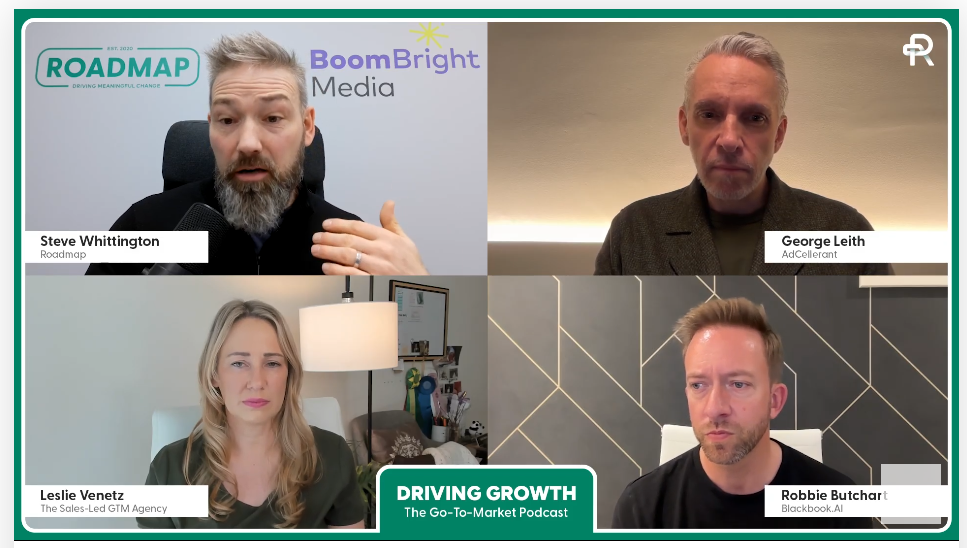
The sellers winning in 2026 share three traits: they align sales, marketing, and product around a unified go-to-market strategy, they use at least three outreach channels, and they own the full deal cycle from first touch to post-sale. I sat down with Steve Whittington, Leslie Venetz (founder of The Sales-Led GTM Agency, author of Profit Generating Pipeline), and Robbie Butchart (VP of Growth for North America at Blackbook AI) on Steve’s Driving Growth podcast to debate the biggest issues facing modern B2B sellers. Steve runs Roadmap, and he built his podcast around a belief I share: growth requires engineering, not luck. Here are the takeaways that matter most.
What Needs to Stop in Sales Right Now
Steve kicked things off by asking each of us to name the biggest problem in selling today. Robbie didn’t hold back. He talked about how LinkedIn has become a “debacle”: you accept a connection and immediately get blasted with a generic, AI-generated pitch. “My favorite is when I get ‘Hi insert name’ and they have their placeholder still in the actual outreach,” Robbie said. That spray-and-pray approach assumes the numbers game will drive value. It does not.
Leslie built on that with a point that stuck with me: companies will send 30,000 emails, get 30 responses, and call it a win, while torching 29,970 bridges. “It works as that short-term silver bullet strategy. It absolutely and unequivocally does not work long term. And it also deeply tarnishes the profession of sales because it erodes so much trust.” She nailed it. When we try to reach everybody with the same generic message, we end up speaking to nobody.
I added my own take: we have to stop winging it. Our buyers research extensively before ever talking to a seller. Generic value props and hoping to figure it out on the call no longer cut it. In my current role at AdCellerant, I keep coming back to the importance of getting focused on a valuable ICP you can actually serve well, rather than trying to conquer the world. Buyers are smarter now, and they will identify an unprepared seller within seconds.
Full Cycle Sales Is Making a Comeback
Steve raised the question about whether the old gated sales process (SDRs handing to AEs, AEs handing to customer success) truly serves buyers or just creates unnecessary hoops. The answer depends on deal complexity and size. In programmatic display advertising, we deal with buy-by-committee scenarios: procurement, IT, compliance on both sides. I’ve got my head of engineering on calls with their head of IT, my compliance team talking to theirs. In that kind of enterprise sale, you can’t just hand it off. You need someone to quarterback the deal all the way through.
For smaller, more transactional deals, an SDR motion makes sense. The real question is whether that SDR needs to breathe air or runs on a chip. I have friends using AI SDRs right now doing a great job. And the core purpose of an SDR is simple: help people stop wasting their time, both the buyer and the seller.
Robbie agreed from his experience building software companies. “Sales is all about how you make people feel. I hate that feeling when you start with one person and then all of a sudden you get flipped over to somebody else. I feel like a number.” He stays involved through the entire cycle, even post-sale, through what he calls “quarterly innovation routes” instead of traditional QBRs.
Leslie brought a balanced perspective. She has worked as both a full-cycle inside sales rep and an AE with SDR alignment, and she still believes the SDR-to-AE model works. But it got overused during the “growth at all costs” era when companies threw bodies at revenue. “If we think about how much a good AE costs, I do not want that person whose core expertise is running middle and bottom of funnel to also be manually going through a list.” She loves the emergence of roles like the GTM Engineer, someone who bridges sales and RevOps to accelerate what a senior seller can do.
Buyer Expectations Are Shifting Fast
Steve asked Leslie to kick off the buyer expectations discussion. If you sell a flat-rate SaaS product and gate your pricing behind a sales call, buyers are done with you. “I know many buyers that will not buy with you out of principle if that’s the way you operate.” She also cited Gartner data about 72% of B2B buyers preferring a sales-rep-free experience, but stressed that those buyers who skipped the rep are significantly more likely to regret their decision. The takeaway: buyers reject bad reps, not all reps.
Nobody has to put up with a bad seller. Everything has multiple providers. One question I always ask when evaluating a vendor: “What happens when something goes wrong? How are you going to handle it?” Because it will happen. I sold for a long time, coached sellers for years, and then spent a couple of years as the buyer. It was humbling. But it taught me something important: if you can’t have a technical conversation with a buyer who knows their stuff, you’re dead in the water. Because there will be someone else who can.
Robbie brought up a crucial insight about education versus selling. “We need to educate these people rather than trying to sell them something. We need to help them walk down that path because there’s so much information out there, so much shiny object syndrome.” He shared his “3-3-3 rule”: 3 minutes researching the person, 3 minutes on the company, 3 minutes on the role. If you can’t find much on the company, research competitors. Nine minutes of prep makes you dangerous and intelligent in the conversation.
Old School Is the New School
When Steve asked what tactics are making a comeback, Robbie’s answer was instant: “Making phone calls, baby!” People are picking up the phone again. He always asks his clients which outreach they actually respond to, and the answer keeps coming back to the phone. He also talked about direct mailers: his team sent old-school keys in a black box, and people called back and replied on LinkedIn. He also made the case for dropping in on clients in person, a practice that largely disappeared during COVID.
Leslie doubled down on this and emphasized using a minimum of three channels. “What I often hear reps say is ‘I prefer LinkedIn. I don’t like to make cold calls.’ It is not about you. It is about using at least three channels because you are then giving your prospects the opportunity to engage with you on their preferred channel.” She also brought up writing call screening scripts for the new iOS feature on iPhones. Instead of treating cold calling as dead, she sees it as another opportunity to build trust and awareness through push notifications.
Steve turned to me about face-to-face engagement. I travel extensively for my role, and it represents a massive investment. One play I’m focused on right now is determining outcomes before going on a tour. At some point, someone will ask how that $25,000 trip translated into pipeline. You need to have a clear answer. The other way to justify the investment is to make travel part of your content strategy. Take photos with customers. Post about them on LinkedIn and X. Don’t leave those pictures on your phone.
I love the term Leslie and Robbie used: “putting heat around the prospect.” That heat can’t come from one channel. It needs to be the entire strategy: LinkedIn, email, phone, social, content, events, direct mail, all working together. And then you have to measure the ROI.
The Way Forward: Alignment Is Everything
When Steve asked me to lay out the path forward, I didn’t hesitate. Modern organizations that want to win need to stop holding separate sales, marketing, finance, and product meetings and instead bring everyone to the table to define a unified go-to-market strategy. I used an analogy: remember making copies of music on cassettes or CDs? Every copy degrades the content. The same thing happens when the product team hears about a customer conversation secondhand. If they’re good, they want to talk to customers directly. They want to understand what resonates.
You have to walk the walk. The good news is everybody really does want to come to the table, and more organizations are starting to adopt that approach.
Leslie added that the organizations succeeding in 2026 are the ones building buyer-centric sales processes and questioning how they use AI. Most companies ask, “Does this make my reps faster?” The better question is, “Does this erode trust?” Because without trust, you’re not driving revenue.
Robbie closed things out with a strong message: take extreme ownership of your pipeline and be brutally honest about which activities actually generate opportunities. “If you can be critical about yourself and ask why you’re going for beers on a Tuesday with your buddy from grade 10, and remove that from your calendar and only focus on revenue-generating activities, you’re going to get wins.”
Your Move This Week
Pick one action and do it in the next seven days. Audit your outreach channels: are you using at least three, or are you leaning on one? Try Robbie’s 3-3-3 rule on your next ten prospects and track whether your reply rates climb. Pull your sales, marketing, and product leads into one room and ask them to define your ICP together. If you want the full conversation, watch the Driving Growth episode and see where these conversations continue at events around the world.