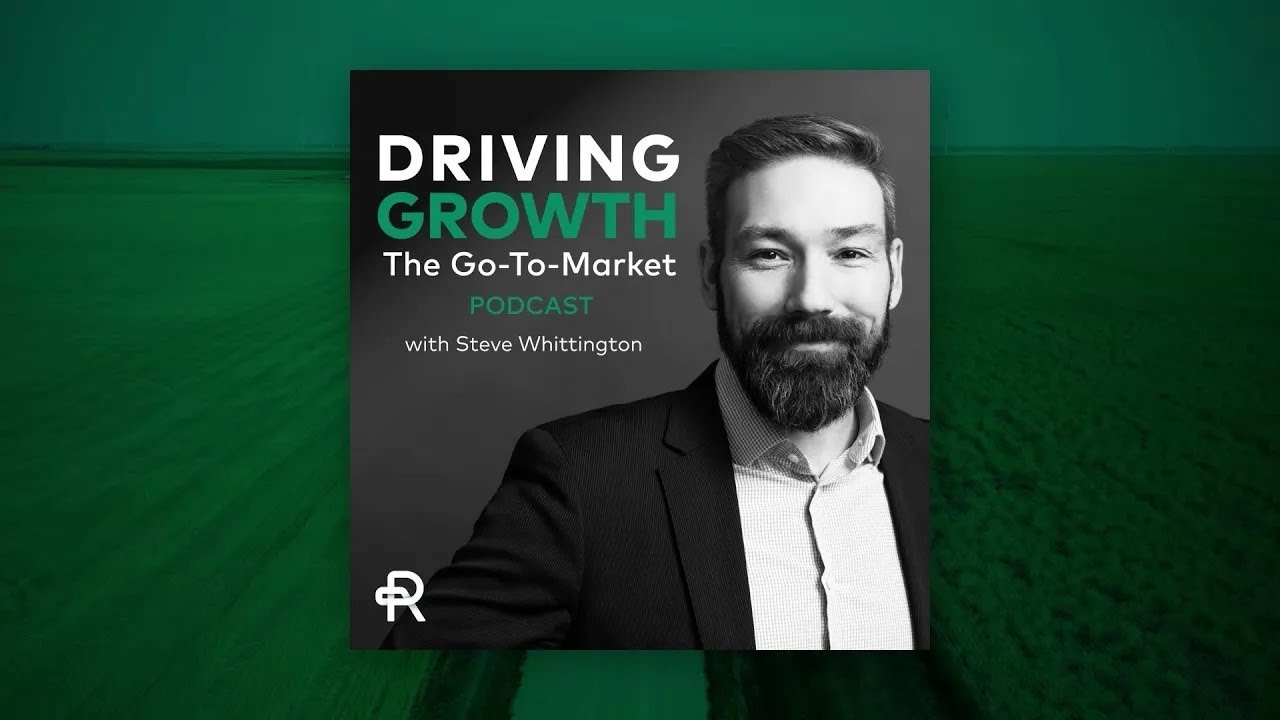
I recently sat down with Steve Whittington on his Driving Growth podcast to talk about something I’ve spent over three decades learning the hard way: sales is not luck. It’s a science. And if you treat it like a guessing game, you’ll lose to someone who doesn’t.
Steve is the president of Roadmap, an agency that builds go-to-market systems for traditional B2B businesses. His podcast is built around a concept I believe deeply in: turning your company into a revenue factory with predictable, repeatable systems.
We covered a lot of ground in this conversation, from customer data and digital transformation to building competency models for sales teams. Here’s what I shared.
It All Starts with Knowing Your Customer
Steve asked me about the pivotal moment in my career where I started to realize the importance of building strong go-to-market foundations. The answer comes down to one thing: data.
I spent a decade at Vendasta, a Saskatoon-based software company, and then moved into the media world as EVP and Managing Partner at Harvard Media. In both cases, the organizations that succeeded were the ones that took the time to understand their existing customers before chasing new ones.
Here’s a story I told Steve. At a previous organization, I sat down with all the revenue leaders and asked a simple question: “Who are our top 500 customers, and what do we know about them?” People in that room had anywhere from 5 to 40 years of experience. And nobody had a clean answer.
That data was scattered, incomplete, and often wrong. And this was a large organization. The reality is, most companies do not have good customer data, regardless of their size or tenure. If you don’t know where you’re winning and where you’re losing with your existing customers, how can you define your ideal customer profile?
Your ICP Should Come from Your Best Customers
Steve brought up the concept of the Ideal Customer Profile (ICP), and I told him that this is where most companies get it backwards. They build an ICP based on wishful thinking instead of looking at the data from the customers they already serve well.
As I explained on the show, “Who are our top 500 customers and what do we know about them?” is not just a question. It’s the foundation of your entire go-to-market motion. You need to look at your existing customer base, understand where you’re successful, and then build your ICP from there.
This applies whether you’re a 5-person startup or a 500-person organization. Start with the data you have. Don’t skip it.
Digital Transformation Is Not Optional
Steve and I spent time talking about what happens when traditional businesses try to go digital. At Harvard Media, I led the company’s transition to a digital-first business model. That meant restructuring how we operated and aligning with how people actually consume media today.
I’ve seen it over and over: businesses that resist digital transformation don’t just fall behind, they become irrelevant. The buyers have changed. They’re doing their research online before they ever talk to a salesperson. If you haven’t built the digital infrastructure to meet them where they are, someone else will.
But here’s the catch. Digital transformation doesn’t work if you just throw technology at people who aren’t ready for it. One of the biggest pitfalls I’ve seen is putting a tech layer on top of a team that’s never used the tools before and expecting magic to happen. As I told Steve, you’ve got to train them, model it out for them, and show them what’s in it for them. If people can’t see how the change makes them more money or makes their job easier, they won’t adopt it.
Building a Revenue Factory: The Framework
Steve’s podcast is called Driving Growth for a reason. He’s passionate about building systems that create predictable revenue. And that’s exactly the framework I walked through on the show.
A revenue factory has a few core components:
- Structured customer and sales data that tells you where to focus
- A clearly defined ICP built from your best existing customers
- Performance metrics that are actionable, not just interesting
- Competency assessments that help you identify and develop the right sellers
- A cadence of communication and measurement that keeps the team aligned
I told Steve about the lesson I learned the hard way with metrics. I used to track 45 to 55 metrics on a weekly basis. Eventually, I got it down to seven. The question that changed everything for me was: “What metrics can I actually take action on that will change the course of the business?”
You want maybe one or two lagging metrics on your scorecard, but the rest should be leading indicators that you can influence. That’s where the real leverage is.
Competency Assessments: Know Your Team
One of the areas Steve and I dug into was how to evaluate and develop a sales team. I’m a big believer in competency assessments. Before you can train someone or coach them, you need to understand where their strengths and gaps are.
I’ve found that when you combine competency data with performance data, you start to see patterns. Some sellers are great at opening but struggle to close. Others have deep product knowledge but can’t build rapport. The assessment gives you a roadmap for development.
And this ties directly back to the revenue factory concept. If you’re building a scalable revenue team, you need to know what “good” looks like at every stage of the pipeline. You can’t scale what you can’t measure, and you can’t measure what you haven’t defined.
Mistakes I’ve Made (and What I Learned)
Steve asked me about the pitfalls I’ve seen in building go-to-market systems, and I was honest. I’ve made plenty of mistakes myself.
One of the biggest: measuring too much. When you have 45 metrics on a dashboard, nobody knows what to focus on. The team gets overwhelmed, and nothing moves. Getting that number down to seven was a game changer for me.
Another mistake: assuming that a CRM or a piece of technology will fix a broken process. Technology amplifies whatever you already have. If your process is broken, tech makes it break faster. If your process is solid, tech makes it scale.
And then there’s the human side. I shared something with Steve that I believe deeply: “There’s no other job in the world where you get punched in the face all day and then at 3:30 somebody says yes to you and you go, it’s the greatest job ever.” Sales is hard. The majority of it is failure. You need people who can handle that rhythm and still show up the next day.
The Rhythm of Revenue
One concept that came up in our conversation was the idea of rhythm. Every high-performing sales organization has one. It’s the cadence of communication, the consistency of measurement, and the discipline to keep going when things get tough.
Steve described it well when he talked about creating “rhythm events,” those regular touchpoints where the team comes together to review progress, adjust strategy, and stay aligned. I’ve seen this work in practice. The organizations that have a weekly operating rhythm outperform those that don’t, every time.
The key is to keep it simple. Don’t overload your meetings with 20 agenda items. Focus on the metrics that matter, talk about what’s working and what’s not, and make decisions quickly. That’s the rhythm that drives revenue.
What I’d Tell Every Sales Leader Right Now
If I could boil this entire conversation down to a few core principles, it would be these:
- Start with your customer data. Know your top customers, understand why they buy from you, and build your ICP from reality, not assumptions.
- Invest in digital transformation. Your buyers have already gone digital. If you haven’t, you’re invisible to them.
- Measure what matters. Seven metrics that drive action will always beat 50 that gather dust.
- Assess your team’s competencies. You can’t develop what you don’t understand.
- Build a rhythm. Consistent communication and measurement is what separates predictable revenue from random acts of sales.
The Bottom Line
Sales has changed. The buyers are smarter, the tools are better, and the competition is fiercer than ever. But the principles haven’t changed. Know your customer. Use your data. Build systems that scale. And never stop developing your people.
I’m grateful to Steve Whittington and the Driving Growth team for having me on. If you’re a B2B leader trying to build predictable revenue, I’d encourage you to watch the full episode above and subscribe to the podcast.